I still remember the first time I had to rethink my favorite high-intensity interval training (HIIT) session because my knees were nagging. I’d always loved short, punchy workouts that left me breathless and efficient with my time. But when mild knee pain crept in, I realized that intensity doesn’t have to mean high-impact or reckless. You can preserve the cardiovascular and metabolic benefits of intervals while protecting your knees — if you adapt tempo, volume and movement choices intelligently.
Understanding “mild knee pain” and what it means for HIIT
When I say "mild knee pain," I mean discomfort that doesn't stop you from walking or doing daily tasks, but shows up during or after exercise — a twinge or ache rather than sharp pain or swelling. That distinction matters. Sharp, sudden pain or significant swelling needs assessment by a clinician. Mild, persistent discomfort often responds to changes in load, mechanics and recovery.
Two key ideas to keep in mind:
- Load matters: Many knee problems are aggravated by sudden, repetitive loading — think jump landings, quick decelerations, deep squats under load.
- Movement quality matters less than consistency: Small, consistent adjustments over weeks are more helpful than one-off “perfect form” attempts.
Principles I follow when adapting HIIT for sore knees
Over the years I’ve landed on a few simple rules that let me keep interval training effective while protecting my joints:
- Replace high-impact with low-impact movements that preserve power and heart rate but reduce joint pounding.
- Control tempo — slower, deliberate transitions reduce collision forces; controlled acceleration preserves intensity if you lengthen intervals slightly.
- Prioritize recovery signals — if pain worsens with a drill, regress immediately; if it improves, you can slowly reintroduce load.
- Progress gradually — increase interval intensity or complexity one variable at a time (duration, work/rest ratio, frequency).
Low-impact interval substitutions I use
Here are movement swaps I’ve used in place of classic high-impact HIIT moves. They keep the cardiovascular stimulus high without the pounding:
- Replace running sprints with bike sprints (stationary or spin bike). You still get high cadence and lactate build-up with minimal knee impact.
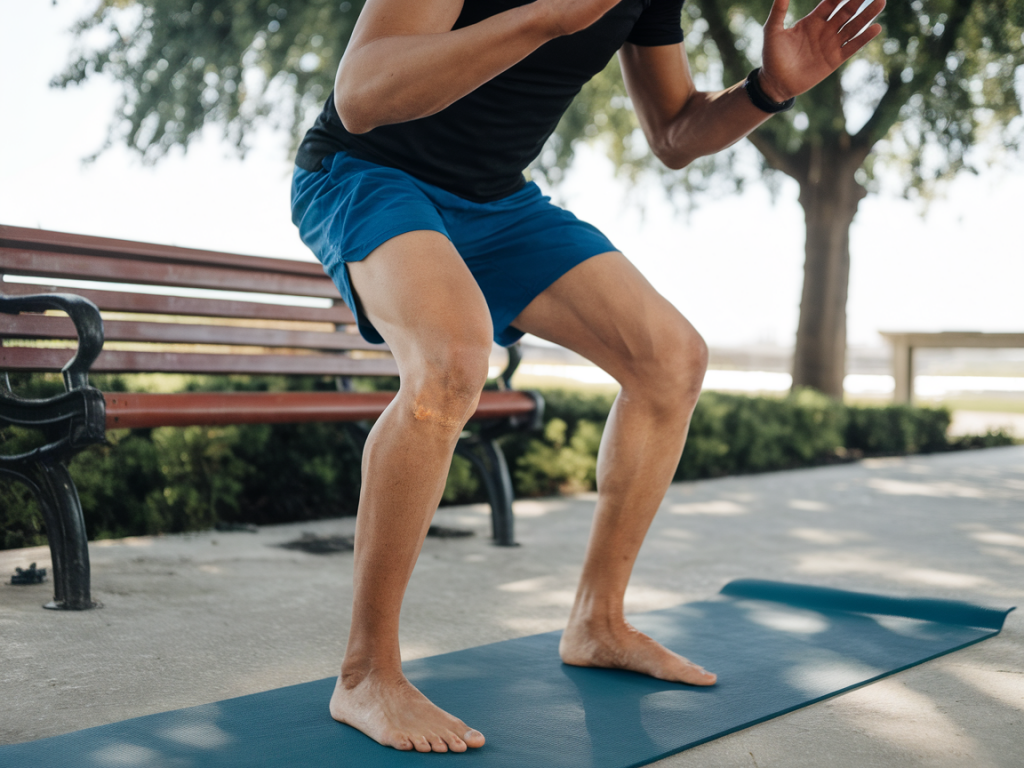
- Swap jump squats for tempo squats (slow 3–4s eccentric, quick concentric) or pulse squats — preserves muscular effort without the impact spike.
- Swap burpees for a mountain-climber-to-plank sequence or kettlebell swings — these keep heart rate elevated while reducing repetitive knee flexion/extending impacts.
- Replace box jumps with step-ups at pace or incline treadmill intervals (walk/run at low impact).
Tempo tweaks that reduce knee stress but keep intensity
Tempo is one of the most practical levers. I like to manipulate tempo in three ways:
- Slow down the eccentric (down) phase: A 3–4 second descent into a squat or lunge reduces impulse and gives you time to load through muscles instead of joints.
- Explosive concentric but controlled landing: If you still include hops or bounding, emphasize soft, deliberate landings with bent hips and knees to absorb force.
- Adjust work/rest ratio: If you lower impact, you can slightly lengthen work intervals (e.g., 40s work / 20s rest instead of 20/10) to maintain cardiovascular stress.
Sample 6-week progression table
| Week | Interval Structure | Movement Examples | Goal |
|---|---|---|---|
| 1–2 | 6×30s work / 30s rest, 2× week | Bike sprints, step-ups, tempo squats | Maintain HR zone 80–90% peak, limit knee pain to ≤2/10 |
| 3–4 | 8×40s work / 20s rest, 2–3× week | Incline treadmill walk/jog, kettlebell swings, mountain-climber sets | Increase metabolic demand while monitoring comfort |
| 5–6 | 10×30s work / 15s rest, 2–3× week | Short bike sprints, step-up power pulls, controlled jump variations (if pain-free) | Reintroduce higher cadence/plyometric elements cautiously |
Signals to watch during and after workouts
I always teach people to use a trio of feedback measures: pain quality, timing and duration.
- Quality: Aching or tightness that eases within 24–48 hours is often okay. Sharp, stabbing or catching sensations are red flags.
- Timing: Pain during impact or at a specific range of motion suggests a movement that needs changing. Pain delayed by 1–2 days may reflect overload rather than acute injury.
- Duration: If pain persists beyond 72 hours or worsens with daily activities, back off and seek professional advice.
Practical recovery cues I use:
- If discomfort rises above 4/10 during a drill, stop and regress.
- If soreness lingers beyond 48–72 hours, reduce frequency or intensity the following week by 30–50%.
- Ice for 10–15 minutes post-session only if swelling or sharp pain occurs; otherwise prioritize movement and gentle mobility.
Strength and mobility work that supports intervals
Intervals are only one piece of the puzzle. I pair them with targeted strength and mobility to offload the knee and improve resilience:
- Hamstring and glute strengthening: Romanian deadlifts, single-leg RDLs, glute bridges. These reduce knee loading by improving hip contribution.
- Quadriceps control: Split squats, slow goblet squats, and eccentric-focused leg work help tendons and muscle control.
- Hip and ankle mobility: Limited ankle dorsiflexion or hip mobility increases knee stress. Simple ankle-toe mobilizations and hip CARs (controlled articular rotations) are useful.
- Single-leg balance and loaded carries: Farmer carries and single-leg stands build joint stability for lateral and rotational loads.
Tools and products I’ve found useful
Over the years I’ve used a few items that make adaptation easier. None are magic bullets, but they help:
- Stationary bike or spin bike — great for high-power intervals without impact. Brands like Peloton or Schwinn are options depending on budget.
- Soft plyo step or adjustable bench — for controlled step-ups and eccentric-focused lifts.
- Kettlebells — swings and goblet squats transfer force without repeated jarring landings.
- Compression sleeves — some people find mild symptom relief and confidence with a simple knee sleeve during workouts.
When to get professional help
I err on the side of caution. See a physiotherapist or sports clinician if you experience:
- Sudden severe pain or inability to weight-bear.
- Persistent swelling, instability or locking sensations.
- No improvement after 2–4 weeks despite sensible load modification.
I’ve kept interval training in my routine during bouts of knee discomfort by using thoughtful substitutions, managing tempo and leaning on gradual progressions. You don’t need to abandon HIIT to protect your knees — you just need to be smarter about what you do, how fast you progress, and how you listen to your body.