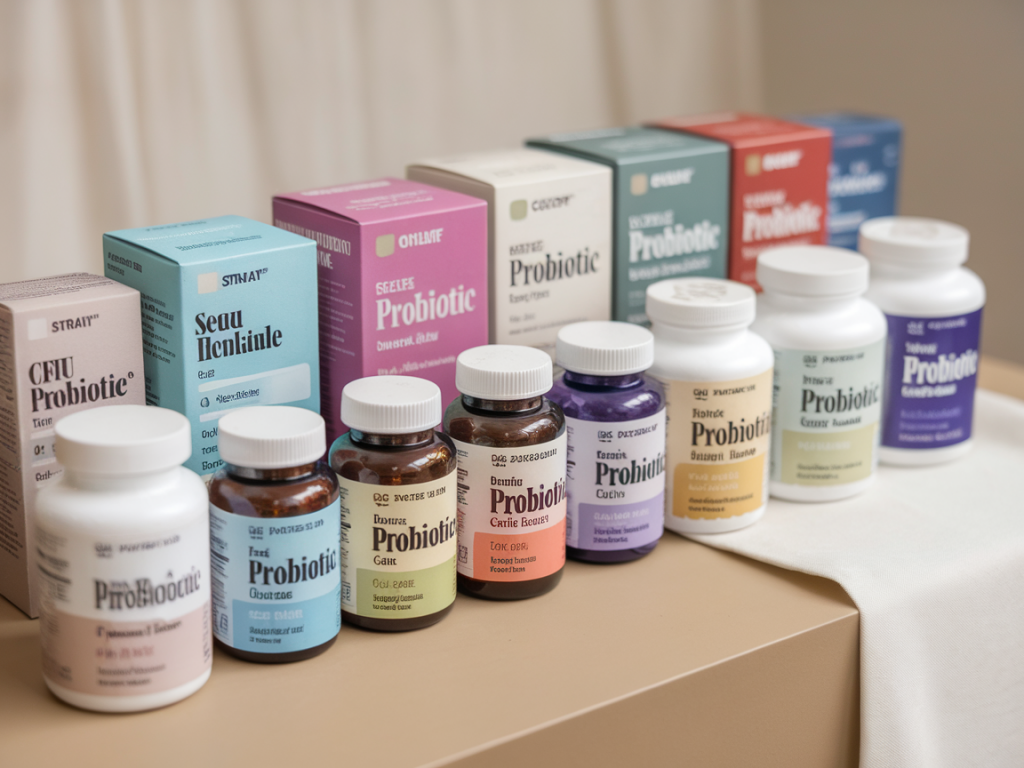
I get a lot of messages from readers asking which probiotic they should buy when they have occasional bloating, loose stools after travel, or mild indigestion. It’s tempting to treat “probiotic” as a one-size-fits-all fix, but the choice actually hinges on three practical things: the strains inside the product, the number of live organisms (CFU), and when and how you take them. Below I walk you through what I look for when I choose a probiotic for short-term digestive upsets, with real-world tips that make it easier to pick something that’s likely to help.
Why strains matter more than the label “probiotic”
Think of a probiotic like a tool in a toolbox. Different strains are built for different jobs. A product that helps with occasional constipation might not be the one you’d choose for traveller’s diarrhoea or antibiotic-associated diarrhoea. So the first question I ask is: what symptom am I targeting?
- Traveller’s diarrhoea and acute diarrhoea: I look for Saccharomyces boulardii (a yeast probiotic) or Lactobacillus rhamnosus GG (often shortened to LGG). Both have strong evidence for reducing duration and severity.
- Antibiotic-associated diarrhoea: S. boulardii and some Bifidobacterium and Lactobacillus combos are commonly studied. S. boulardii is especially useful because it’s a yeast and not killed by antibiotics.
- Bloating and mild IBS-type symptoms: Some people find Bifidobacterium infantis or Bifidobacterium longum helpful. Multi-strain formulas that include bifidobacteria plus lactobacilli can also be useful.
- General digestion support: A broad-spectrum product with clinically-studied strains like LGG, B. lactis, and L. acidophilus is a reasonable choice for occasional, non-severe symptoms.
When brands list Latin names with strain IDs (e.g., Lactobacillus rhamnosus GG or LGG, Bifidobacterium animalis subsp. lactis BB-12), I pay attention. Those strain IDs mean the exact microbe has been studied — which matters for predicting effect.
CFU: how many is enough for occasional issues?
CFU stands for colony-forming units and tells you how many live microbes are in each dose. Higher isn’t always better, but you do want a product with enough organisms to survive the acidic stomach and reach the gut in meaningful numbers.
- Typical range: For most over-the-counter probiotics aimed at digestive support, I look for 1–10 billion CFU per dose for single-strain products, and 10–50+ billion CFU for multi-strain blends.
- Acute or severe diarrhoea: Trials often use higher doses (e.g., 10–40 billion CFU) or well-studied dosages of S. boulardii (typically 250–500 mg/day) or LGG (around 10 billion CFU/day).
- Short-term use: For occasional problems, a 7–14 day course at a clinically-supported dose is usually enough to see benefit.
I prefer products that state CFU at the end of shelf life (not just at manufacture). That tells me the manufacturer expects those microbes to survive until the use-by date.
Timing and how to take them
When you take a probiotic affects how many organisms survive the stomach acid. Here are practical timing tips I use and recommend:
- With food: Many probiotics survive better taken with a meal, especially one that contains some fat. I usually take mine with breakfast or lunch.
- Avoid simultaneous antibiotics (unless yeast-based): If you’re on antibiotics and choosing a bacterial probiotic, separate doses by 2–3 hours. If you choose S. boulardii (a yeast), you can take it alongside antibiotics because it won’t be killed by them.
- Consistency matters: Take a probiotic daily at roughly the same time for the course you’ve picked. For occasional issues, 7–14 days is common; for travel, start a day before travel and continue through the trip and for a couple of days after.
Storage and packaging
Some probiotics require refrigeration, others are shelf-stable. I check packaging and storage instructions carefully because heat and humidity can kill live microbes.
- Refrigerated products often contain strains that are more sensitive to heat but can be highly effective. Keep them cold from purchase to home storage.
- Shelf-stable strains (like many Bifidobacteria and Lactobacilli) are easy for travel. S. boulardii is usually shelf-stable too.
- Packaging matters: Blister packs or dark glass bottles that limit moisture and oxygen exposure are helpful. Some modern formulas use delivery technologies (enteric coating) that help organisms survive stomach acid.
Safety and who should be cautious
For most healthy adults, short-term use of common probiotics for occasional digestive issues is safe. However, I always flag a few situations where extra caution or medical advice is warranted:
- People with severe immunosuppression or central venous catheters should consult a clinician before using live probiotics.
- If you have an indwelling medical device or are critically ill, avoid self-prescribing without professional input.
- Infants, pregnant women, and people with complex medical conditions should talk to their healthcare provider about specific strains and doses.
Quick comparison table of commonly used strains
| Strain | Typical use | Typical dose used in studies |
|---|---|---|
| Saccharomyces boulardii | Traveller's diarrhoea, antibiotic-associated diarrhoea | 250–500 mg/day |
| Lactobacillus rhamnosus GG (LGG) | Acute diarrhoea, traveller's diarrhoea | ~10 billion CFU/day |
| Bifidobacterium infantis | Bloating, IBS-type symptoms | 1–10 billion CFU/day (varies) |
| Bifidobacterium & Lactobacillus blends | General digestive support | 10–50+ billion CFU/day |
Practical product picks I’d consider
If you want a quick shortlist to look for while shopping or online, here are types of products I often recommend readers try depending on their need:
- Traveller’s diarrhoea: S. boulardii (brands: Florastor, Biocodex) or LGG (products like Culturelle).
- After antibiotics: S. boulardii or a multi-strain product with Bifidobacteria + Lactobacilli at a moderate CFU.
- Bloating/mild IBS: A targeted bifidobacteria formula (e.g., B. infantis) or a clinically-tested combination product.
- Easy everyday choice: A shelf-stable multi-strain supplement listing strain IDs and CFU at end-of-life, from a reputable company with clear storage guidance.
When I recommend specific brands, I focus on transparency: companies that list the exact strains, CFU at expiry, batch numbers, and ideally cite research. That’s the difference between a hopeful supplement and one you can reasonably expect to work.
Final practical checklist before you buy
- Is the strain matched to your symptom (S. boulardii or LGG for diarrhoea; Bifidobacteria for bloating)?
- Is the CFU in the range used in clinical studies for that condition?
- Does the label show CFU at end of shelf life and list strain IDs?
- Does packaging/storage match your needs (travel vs fridge)?
- Are there any safety reasons you should check with a clinician?
Picking a probiotic for occasional digestive issues doesn’t have to be intimidating. Focus on the strain, an evidence-based dose, and sensible timing and storage. If you try one and don’t notice improvement after a week or two, switch to another targeted option or check in with your healthcare provider — and if symptoms are severe, get professional advice promptly.