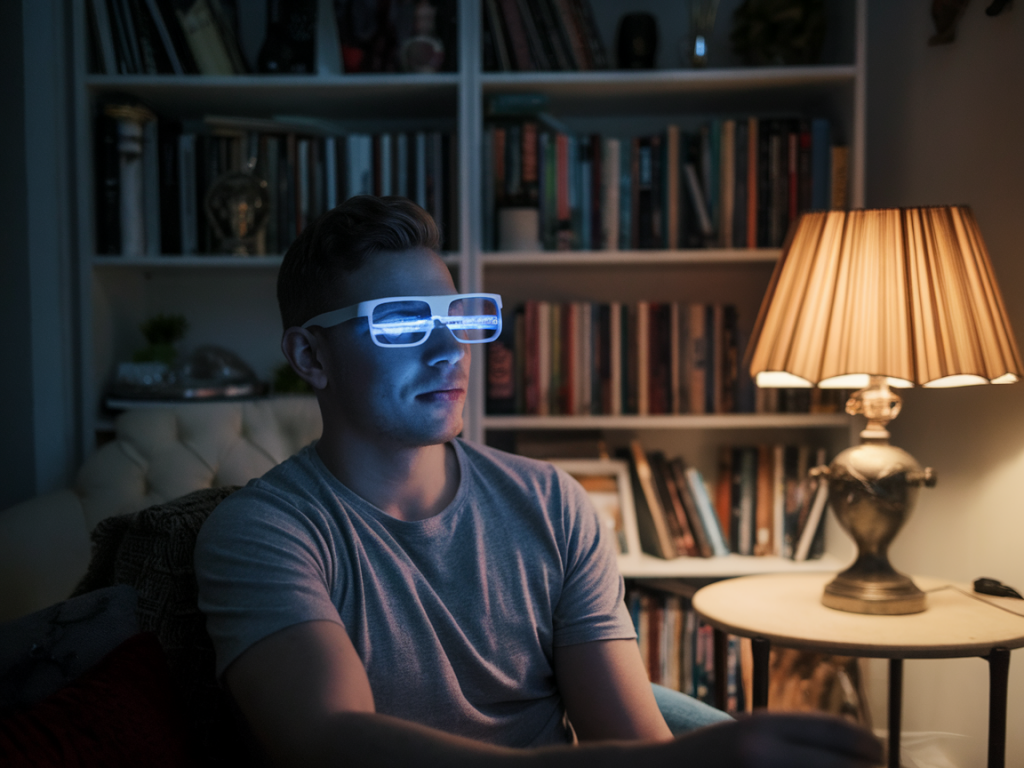
I started wearing blue-light blocking glasses some evenings after months of restless sleep and bedtime scrolling. Like many people, I was suspicious that my phone and laptop were sabotaging my sleep, but also skeptical that a pair of tinted lenses could make a measurable difference. After reading the science and trying a few approaches myself, I’ve found the reality is a little more nuanced than the hype — and more promising when you know how to use them properly.
Why blue light matters for melatonin and sleep
Blue light (roughly 460–480 nm) has a powerful effect on our internal clock. Specialized retinal cells — intrinsically photosensitive retinal ganglion cells (ipRGCs) — are particularly sensitive to blue wavelengths and signal the brain’s master clock (the suprachiasmatic nucleus) to suppress melatonin and increase alertness. This mechanism evolved to help us be awake during daylight and wind down after sunset.
In modern life, exposure to artificial blue-rich light from screens, LED bulbs and even some energy-efficient lamps can delay melatonin onset and shift your sleep window later. That’s where blue-light blocking glasses come in: they aim to reduce the short-wavelength light reaching the retina in the evening so melatonin can rise naturally.
What the evidence says
There are randomized controlled trials and laboratory studies that show wearing orange-tinted lenses or orange light filters in the 2–3 hours before bedtime can increase melatonin levels and improve sleep timing. But the effect size and real-world impact vary based on the lens’ spectral cutoff, the timing of use, and what you pair them with.
| Study | Intervention | Main finding |
|---|---|---|
| LeGates et al. (2012, mice) | Blue light exposure vs. dim light | Blue light suppressed melatonin-equivalent signaling and shifted rhythms |
| Burkhart & Phelps (2009) | Orange-tinted glasses for evening computer users | Increased nocturnal melatonin and improved sleep quality scores |
| Figueiro et al. (2011) | Short-wavelength-blocking glasses in shift workers | Reduced melatonin suppression during night shifts; improved sleep timing |
| van der Lely et al. (2015) | Blue-blocking glasses in adolescents | Advanced melatonin onset and improved sleep duration |
Not all studies are unanimous. Some trials using clear lenses that claim to “filter” blue light show minimal effect. The most robust findings involve lenses that filter a significant percentage of light below ~500 nm — typically orange or amber lenses — worn for at least 1–2 hours before bedtime.
How effective are they after 9pm?
If you strictly ask whether wearing blue-light blocking glasses after 9pm will actually improve melatonin and sleep quality, the short answer is: yes, they can — especially if your natural bedtime is earlier and you’re getting evening screen exposure. But the magnitude depends on how you use them.
Key points that shape effectiveness:
What I noticed when I tried them
When I started using orange-tinted blue-blockers around 9pm, I noticed a few differences within days: it felt slightly easier to wind down, I had less late-evening alertness, and my time to fall asleep shortened by about 10–20 minutes. Those subjective gains matched what some small studies report. I also combined glasses with dimming my room lights and shutting off work devices earlier, which likely amplified the effect.
One important caveat: if you’re already exposed to bright light earlier in the evening (for example, working under bright task lighting or using HDR screens), glasses are more helpful. If your evenings are already dim and screen time is minimal, the marginal benefit is smaller.
How to choose the right glasses
Here’s what I recommend looking for:
Practical tips for real-world use
Blue-blocking glasses are not a magic bullet. They’re a tool that works best as part of an evening routine. Here’s how I integrate them:
Common questions people ask
Will they fix insomnia? Not necessarily. If your sleep problems stem from anxiety, sleep apnea, chronic pain, or circadian disorders, glasses might help a little but won’t address the root cause. They’re most impactful for people whose sleep delay is partly due to evening light exposure and late-night screen use.
Are they worth the cost? For many people, yes — especially if you prefer non-pharmacological approaches. Even inexpensive amber glasses can have measurable effects. If you’re unsure, try a low-cost pair for a couple of weeks and track your sleep latency and perceived sleep quality.
Do blue-light blocking lenses affect daytime vision or mood? High-tint evening glasses are not meant for daytime use; wearing them in daylight can reduce contrast and may impair tasks that require accurate color perception. Most users keep them for evening-only use.
How to test whether they help you
I find a simple personal trial useful:
If you have a wearable that tracks sleep stages, you may also see a shift toward earlier melatonin onset or a slight increase in slow-wave sleep, but device data can be noisy. Trust how you feel as much as the numbers.
Ultimately, blue-light blocking glasses are a low-risk, low-cost strategy that can meaningfully help people who are exposed to bright, blue-rich light in the evening. When used with dim lighting and consistent bedtime habits, they can make it easier to fall asleep and support natural melatonin production — especially if you start using them around 9pm and keep them on until lights out.